Qovelyra
Luma Sphere
Luma Sphere
Couldn't load pickup availability
1. When Light Has No Direction
A design study can include a strong subject, yet still feel unclear when light is not planned with intention. Learners may describe color, objects, or mood, while leaving brightness, contrast, and depth too vague. This can create visuals where the focal point competes with the background or important details disappear into the scene. Light also affects texture, space, and emotional tone, so unclear lighting notes can shift the full design away from the original idea. Luma Sphere addresses this by placing light at the center of the creative planning process.
2. A Guided Study of Glow, Focus, and Space
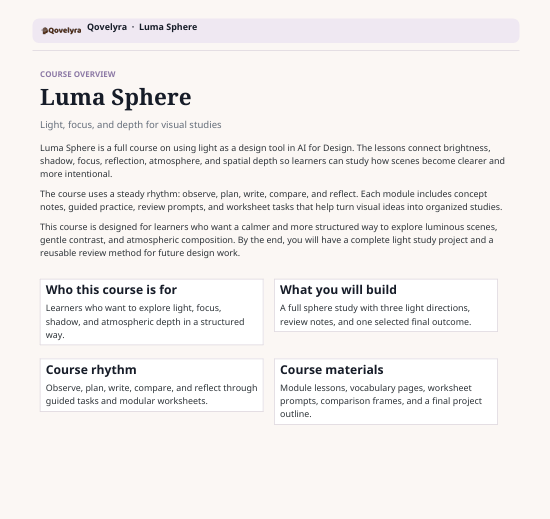
Luma Sphere introduces a structured approach to designing with brightness and spatial atmosphere. The course helps learners describe how light moves through a scene, where it gathers, and how it supports the main subject. Each lesson connects written direction with visual review, so learners can understand how lighting choices change composition and mood. The course also studies how shadow, reflection, haze, and contrast can shape depth. Learners develop a practical method for creating design studies where light becomes a clear part of the concept rather than an afterthought.
3. What’s Inside
The course begins with a module on light direction. Learners study front light, side light, backlight, overhead light, soft glow, reflected brightness, and low-light scenes. Each lighting type is connected to short visual exercises that show how brightness changes the presence of the subject.
A second module focuses on focal glow. Learners practice writing notes that guide attention toward one area of a composition. This section covers highlight placement, surrounding darkness, edge brightness, subtle shine, and the relationship between illuminated and quiet areas of an image.
The next section explores depth and space. Learners study foreground light, background fade, atmospheric haze, shadow layers, reflective surfaces, and distance cues. These ideas help learners describe images that feel more dimensional and visually organized.
Luma Sphere also includes a color-and-light module. Learners examine warm glow, cool illumination, muted brightness, color cast, contrast balance, and tonal harmony. The emphasis is on choosing lighting notes that support the intended visual direction.
The course includes a luminous review worksheet. Learners use it to evaluate focus, contrast, shadow, depth, atmosphere, and alignment with the original brief. The final exercise is a sphere study: learners choose one subject, prepare three lighting directions, compare the results, and write a short reflection on how light changed the image.
Included materials feature light-direction sheets, glow vocabulary pages, depth-planning templates, color-light notes, comparison tables, and a final study checklist.
4. Who Is This For?
Luma Sphere is intended for learners who want to study light as a design tool in AI for Design. It suits visual learners, design students, creative makers, and anyone who wants to create more organized scenes through brightness, shadow, and depth.
5. What You’ll Learn
- How to describe light direction in a visual brief
- How to guide attention with brightness and contrast
- How shadow and reflection affect spatial depth
- How to connect color notes with lighting choices
- How to compare several light-based variations
- How to review glow, focus, and atmosphere with structured notes
6. 30-Day Refund Terms
Refund requests may be submitted within 30 calendar days of purchase, subject to the store’s published refund conditions. The request should include the order information needed for review. Refund timing may vary depending on the original payment method and payment provider. This section should be used only when it matches the active Qovelyra refund policy.
Self-paced learning overview
- 📁 Digital file available after purchase
- ♾️ Long-term availability
- 🔒 Secure checkout
- 🗓️ Content updated in 2026
How are the courses structured?
How are the courses structured?
Each tariff follows a clear sequence of modules, guided explanations, visual examples, and practice tasks. Learners can move through the materials in order and revisit earlier topics when they wish.
Who are the courses intended for?
Who are the courses intended for?
The course collection is intended for curious beginners, developing designers, and creative learners who want to explore AI-supported design methods. No prior technical background is required unless a course page states otherwise.
What will I receive after enrollment?
What will I receive after enrollment?
You will receive the lessons, modules, worksheets, prompts, and supporting materials listed on the selected course page. The contents vary by tariff, so each description outlines the exact learning scope.
Share