Qovelyra
Cloud Sphere
Cloud Sphere
Couldn't load pickup availability
1. When the Scene Feels Heavy
Some design studies become too dense because every part of the image asks for attention at the same time. Learners may add rich detail, color, texture, and background elements, yet the final result can feel crowded rather than thoughtful. Atmosphere can also become unclear when space, softness, and distance are not described carefully. Without a method for planning lighter visual structures, a concept may lose its quiet rhythm. Cloud Sphere responds to this by focusing on openness, layered depth, and calm visual breathing room.
2. A Spacious Method for Atmospheric Design
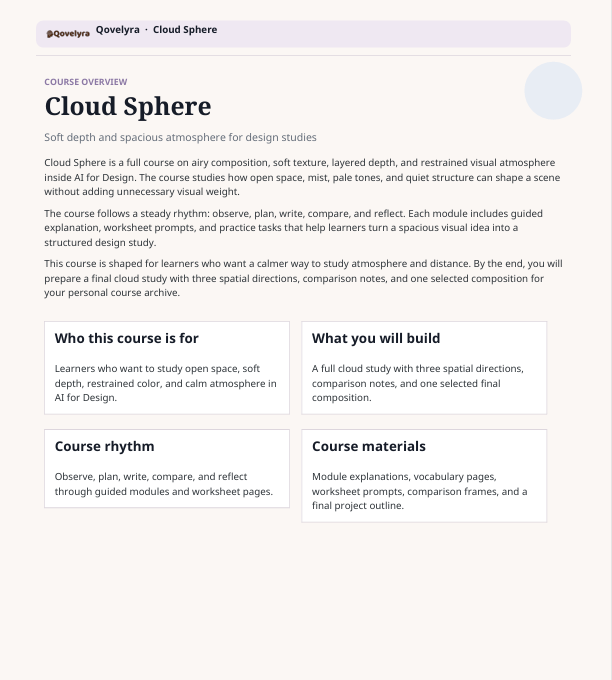
Cloud Sphere introduces a structured way to build visual studies through air, distance, softness, and layered composition. The course helps learners describe scenes where space is not empty, but actively shapes the viewer’s experience. Each module connects written direction with careful visual review, showing how mist, blur, pale light, and gentle contrast can support a design concept. Learners study how to reduce visual noise while keeping the subject clear. The course is intended to help learners create design studies that feel lighter, calmer, and better organized.
3. What’s Inside
The course begins with a module on atmospheric space. Learners explore how to describe open backgrounds, soft gradients, distant forms, floating details, and gentle separation between visual layers. This section helps learners understand how space can guide attention without adding unnecessary elements.
The second module focuses on cloud-like texture. Learners study mist, haze, vapor, soft shadows, diffused light, blurred edges, and delicate surface transitions. These qualities are used to create visual environments that feel calm, airy, and layered.
A depth module follows. Learners practice describing foreground, middle ground, and background in a way that supports distance and visual order. The module includes exercises where the same subject is placed into different spatial settings, such as open skies, pale interiors, fog-filled scenes, and abstract atmospheric fields.
The next section studies restrained color. Learners explore pale palettes, muted contrast, soft tonal shifts, cool-warm balance, and gentle highlight placement. The focus is on using color to support space rather than overpower the composition.
Cloud Sphere also includes a quiet composition worksheet. Learners use it to plan subject placement, empty space, visual weight, background softness, and atmospheric rhythm. A prompt variation section invites learners to create several airy versions of one concept by changing texture, distance, and light.
The final course task is a sphere study built around atmosphere. Learners choose one theme, write a spatial brief, prepare three cloud-inspired directions, compare the results, and complete reflection notes on openness, depth, and clarity.
Included materials feature atmosphere vocabulary sheets, spatial planning pages, cloud texture notes, color restraint exercises, comparison tables, and a final study checklist.
4. Who Is This For?
Cloud Sphere is intended for learners who want to explore softer, lighter, and more spacious design directions. It suits design students, visual learners, creative makers, and anyone interested in calm atmospheric studies within AI for Design.
5. What You’ll Learn
- How to describe airy space in a creative brief
- How mist, haze, and soft edges influence visual mood
- How to create depth through layered composition
- How restrained color can support atmosphere
- How to reduce visual noise while keeping the subject clear
- How to review openness, distance, and spatial rhythm
6. 30-Day Refund Terms
Refund requests may be submitted within 30 calendar days of purchase, subject to the store’s published refund conditions. The request should include the order information needed for review. Refund timing may vary depending on the original payment method and payment provider. This section should be used only when it matches the active Qovelyra refund policy.
Self-paced learning overview
- 📁 Digital file available after purchase
- ♾️ Long-term availability
- 🔒 Secure checkout
- 🗓️ Content updated in 2026
How are the courses structured?
How are the courses structured?
Each tariff follows a clear sequence of modules, guided explanations, visual examples, and practice tasks. Learners can move through the materials in order and revisit earlier topics when they wish.
Who are the courses intended for?
Who are the courses intended for?
The course collection is intended for curious beginners, developing designers, and creative learners who want to explore AI-supported design methods. No prior technical background is required unless a course page states otherwise.
What will I receive after enrollment?
What will I receive after enrollment?
You will receive the lessons, modules, worksheets, prompts, and supporting materials listed on the selected course page. The contents vary by tariff, so each description outlines the exact learning scope.
Share